 Image 1 of 1
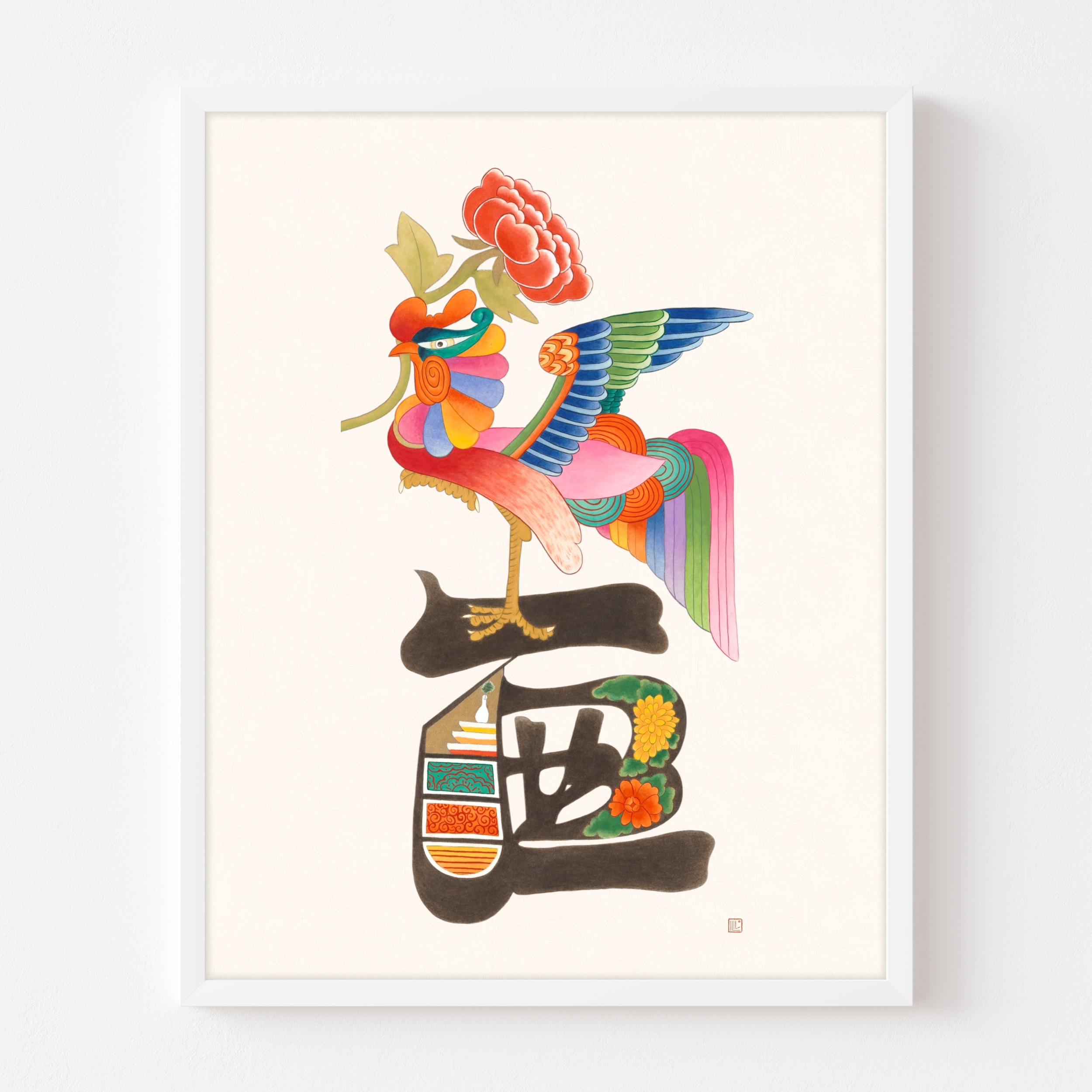
Munjado flourished from the late 1700s through the 1800s as a genre of Korean folk painting where a Chinese character is transformed into a picture. Symbolic images are woven directly into the brushstrokes of the character itself, so the word and the imagery tell a single story together.
This is part of Eight Confucian Virtues – Hyo (孝) · Je (悌) · Chung (忠) · Sin (信) · Ye (禮) · Ui (義) · Yeom (廉) · Chi (恥), typically painted as an eight-panel folding screen to decorate the home.
廉 Yeom — Integrity (incorruptibility and frugality)
Shown with the phoenix, which flies vast distances but refuses to eat common grain symbolizes a noble person’s willingness to step aside gracefully.
Painted with ink and pigments on hanji (Korean mulberry paper). Giclée printed on Hahnemühle German Etching paper.
Note:
The frame is not included.
The print will be professionally printed and shipped to you in a rolled tube. How to flatten rolled artwork.
Send me a message on Instagram for custom sizes.
Munjado flourished from the late 1700s through the 1800s as a genre of Korean folk painting where a Chinese character is transformed into a picture. Symbolic images are woven directly into the brushstrokes of the character itself, so the word and the imagery tell a single story together.
This is part of Eight Confucian Virtues – Hyo (孝) · Je (悌) · Chung (忠) · Sin (信) · Ye (禮) · Ui (義) · Yeom (廉) · Chi (恥), typically painted as an eight-panel folding screen to decorate the home.
廉 Yeom — Integrity (incorruptibility and frugality)
Shown with the phoenix, which flies vast distances but refuses to eat common grain symbolizes a noble person’s willingness to step aside gracefully.
Painted with ink and pigments on hanji (Korean mulberry paper). Giclée printed on Hahnemühle German Etching paper.
Note:
The frame is not included.
The print will be professionally printed and shipped to you in a rolled tube. How to flatten rolled artwork.
Send me a message on Instagram for custom sizes.